

Les Barocudas
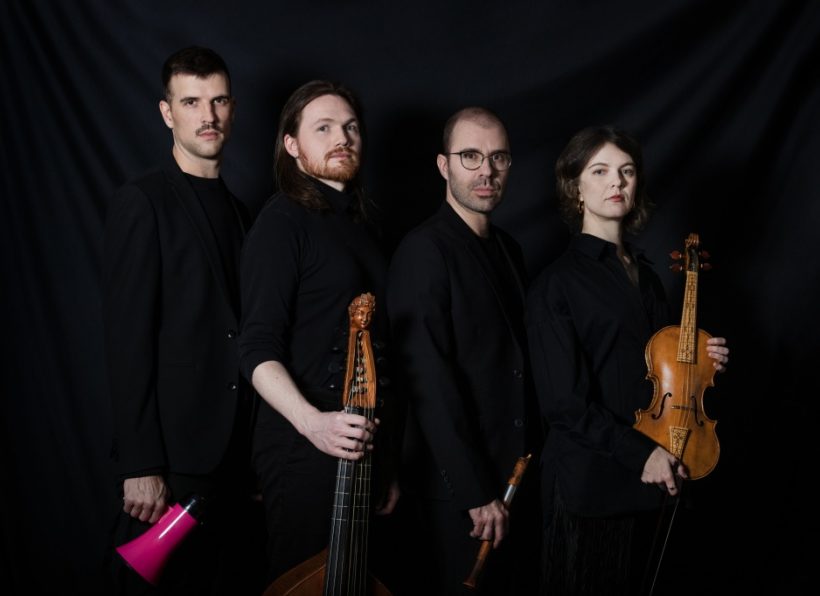
Touring as a quartet!
From their very first album, La peste (ATMA Classique, 2020), Les Barocudas has distinguished themselves through their originality. Inspired by the plague epidemics of the 17th century, this recording for three musicians (violin, viola da gamba/bass violin, and keyboards) offers a program rich in contrasts and atmospheres, acclaimed by both critics and audiences. Nominated for the JUNO and Opus Awards, the album was recognized by CBC Music as one of the best classical productions of the year.
Since then, the ensemble has expanded—incorporating recorder, organ, harpsichord, and baroque harp—and has continued its artistic trajectory with a new acclaimed album, Basta Parlare! (2023), also nominated for a JUNO Award. This recording confirms the group’s originality, its passion for the repertoires of the 17th and 18th centuries, and its ability to make this music resonate with intelligence and passion.
The performances of Les Barocudas—both in concert and on recordings—are characterized by a keen sense of musical expression, natural stage presence, and strong ensemble cohesion.
Far from static reconstructions, their performances offer a vibrant, contemporary, and generous interpretation of early music, breathing new life into forgotten Baroque treasures.
Marie Nadeau-Tremblay
Since graduating in 2019 with a master’s degree in early music, Marie Nadeau-Tremblay has established herself on the Canadian scene as an emerging young baroque violinist. In 2019, she landed an unprecedented four awards at the Mathieu-Duguay Early Music Competition, including First Prize. Named Radio-Canada’s 2021–2022 classical “Revelation” and winner of the 2022 “Discovery of the Year” Opus Prize, Nadeau-Tremblay also received the 2022 Choquette-Symcox Award from the Jeunesses Musicales Canada Foundation. While her album La Peste (2020) earned Juno and Opus award nominations, her most recent album, Préludes et solitudes (2021), which was highly acclaimed by both the CBC and Early Music America, won a 2023 Opus Prize for “Album of the Year.” In 2022, Marie Nadeau-Tremblay received a career development grant from the Fondation Père Lindsay. She performs on an original Thomas Perry violin (1750) as well as on an Amati model violin by Timothy Johnson generously loaned to her by Mr. Jacques Marchand. In addition to music, Nadeau-Tremblay enjoys drawing and is studying Mandarin and Japanese.
Vincent Lauzer
Hailed for his “athletic and virtuoso playing” and “sensitive interpretations”, recorder player Vincent Lauzer leads an active career as a performer, artistic director, and teacher. He is Artistic Director of the Lamèque International Baroque Music Festival, Co-Artistic Director of Les Plaisirs du clavecin, Head of Youth Development with Arion Baroque Orchestra, and since November 2022, he has served as Co-Artistic Director of the Montreal Baroque Festival. In October 2018, his recording of Vivaldi’s concertos with Arion Baroque Orchestra was awarded a Diapason d’or by the renowned French magazine Diapason. In addition to several prizes in national and international competitions, he received the prestigious Fernand Lindsay Career Award in 2015. He was named “Révélation Radio-Canada” in 2013–2014 and “Discovery of the Year” at the 2012 Opus Awards. In 2012, he won First Prize at the Canadian Music Competition’s Stepping Stone and the Career Development Award from the Women’s Musical Club of Toronto. Vincent Lauzer is a member of Flûte Alors! and regularly performs as a soloist with Arion Baroque Orchestra, La Bande Montréal Baroque, the Orchestre symphonique de Montréal, the Pacific Baroque Orchestra and Les Violons du Roy. He has played in various series and festivals in Canada and the United States, as well as in Mexico, France, Germany, Spain and Belgium.
Tristan Best
Tristan Best is an early string instrument player currently based in Montreal, Quebec. With roots in New York and Nova Scotia, Tristan came to Montreal in 2016 to study viola da gamba and early music performance. Tristan holds a bachelor and a master of music in viola da gamba performance after completing his studies at McGill University in 2021 under the tutelage of Betsy MacMillan and Elin Soderstrom. Tristan frequently performs with Montreal-based ensemble Les Barocudas, has participated in the Montreal Baroque Festival, and was awarded the Founder’s Prize along with second place as a soloist in the Mathieu-Duguay Early Music Competition in 2022. Outside of performance, Tristan is also an educator and has given workshops and lectures about the viola da gamba around Canada and the United States.
Christophe Gauthier
Born in Montréal, Christophe Gauthier studied harpsichord with Mireille Lagacé at the Conservatoire de Montréal. He then earned two degrees at the Université de Montréal, his bachelor’s studying with Réjean Poirier and his master’s studying with Luc Beauséjour. His skill as a chamber player has led Christophe Gauthier to help found a number of ensembles, including the Rendez-vous baroque français and the Consort Laurentien. The latter group performed in the summer of 2021 at the Utrecht Early Music Festival in the Netherlands. He performs as organist and harpsichordist with the Studio de musique ancienne de Montréal (SMAM), Arion Baroque Orchestra, I Musici de Montréal, and the Orchestre Métropolitain under the direction of Yannick Nézet-Séguin.
Christophe Gauthier teaches organ and harpsichord at the Cégep de Saint-Laurent. He is regularly invited to teach at the Lunenburg Academy of Music Performance (Nova Scotia). He occasionally directs ensembles from the harpsichord, and conducts the choir Ensemble vocal Vivace. Notably, he has directed performances of the operas Dido and Aeneas by Purcell, Hercules by Handel, and David et Jonathas by Charpentier. He can be heard weekly on Radio VM, where he co-hosts the show Musique classique.
Dès leur tout premier album, La peste (ATMA Classique, 2020), Les Barocudas se sont distingués par leur originalité. Inspiré par les épidémies de peste du XVIIe siècle, cet enregistrement pour trois musiciens (violon, viole de gambe / violon basse, claviers) propose un programme riche en contrastes et en ambiances, salué tant par la critique que par le public. Mis en nomination aux prix JUNO et Opus, cet album figurait parmi les meilleures productions classiques de l’année selon CBC Music.
Depuis, l’ensemble s’est agrandi – intégrant flûte à bec, orgue, clavecin et harpe baroque – et a poursuivi sa trajectoire artistique avec un nouvel album acclamé : Basta Parlare! (2023), également nommé pour un prix JUNO. Cet enregistrement confirme l’originalité du groupe, son amour pour les répertoires des XVIIe et XVIIIe siècles, et sa capacité à les faire résonner avec intelligence et passion.
Les prestations de l’ensemble Les Barocudas – tant en concert que sur disque – se caractérisent par un sens aigu de l’expression musicale, une présence scénique naturelle et une forte cohésion d’ensemble.
Marie Nadeau-Tremblay
Depuis sa graduation en 2019, où elle obtient une maîtrise en musique ancienne, Marie Nadeau-Tremblay a su s’imposer sur la scène canadienne comme jeune violoniste baroque de la relève. En 2019, elle figure quatre fois au tableau d’honneur du Concours international de musique ancienne Mathieu-Duguay, remportant entre autres le premier prix. Nommée « Révélation Radio-Canada 2021-2022 » en musique classique et « Découverte de l’année » aux prix Opus 2022, Marie est aussi lauréate du prix Choquette-Symcox de la Fondation Jeunesses Musicales Canada. Son album La Peste (2020) lui a valu des nominations aux prix Juno et Opus. Son plus récent album, Préludes et solitudes (2021), a été chaleureusement accueilli par la critique, tant par la CBC que par Early Music America, et gagne un prix Opus en 2023 dans la catégorie « Album de l’année ». En 2022, Marie reçoit en outre une bourse de développement de carrière de la Fondation Père Lindsay. Elle joue sur un violon Thomas Perry (1750) ainsi que sur un violon Amati fabriqué par Timothy Johnson, lequel lui est généreusement prêté par M. Jacques Marchand. Outre la musique, Marie aime beaucoup dessiner et étudie le mandarin et le japonais.
Vincent Lauzer
Reconnu pour son jeu «athlétique et virtuose» et pour ses interprétations «senties et sensibles», le flûtiste à bec Vincent Lauzer mène une carrière active à titre d’interprète, de directeur artistique et d’enseignant. Il est le directeur artistique du Festival international de musique baroque de Lamèque, le co-directeur artistique des Plaisirs du clavecin, le responsable du développement jeunesse pour Arion Orchestre Baroque et, depuis novembre 2022, le co-directeur artistique du Festival Montréal Baroque. Son enregistrement des concertos de Vivaldi avec Arion Orchestre Baroque lui a valu, en octobre 2018, un Diapason d’or, décerné par le célèbre magazine français Diapason. Lauréat de nombreux premiers prix lors de concours nationaux et internationaux, il reçoit en 2015 la prestigieuse bourse de carrière Fernand-Lindsay. Il est nommé «Découverte de l’année» au Gala des prix Opus 2012, puis «Révélation Radio-Canada 2013-2014». Il remporte également en 2012 le premier prix du Tremplin (Concours de musique du Canada) ainsi que le Career Development Award du Women’s Musical Club of Toronto. Vincent fait partie de l’ensemble Flûte Alors! et se produit comme soliste avec Arion Orchestre Baroque, La Bande Montréal Baroque, l’Orchestre symphonique de Montréal, le Pacific Baroque Orchestra et Les Violons du Roy. Il a en outre joué dans plusieurs séries et festivals d’envergure au Canada et aux États-Unis, de même qu’au Mexique, en France, en Allemagne, en Espagne et en Belgique.
Tristan Best
Tristan Best est un gambiste originaire de New York et de la Nouvelle-Écosse. Son amour de la musique ancienne le mène à Montréal en 2016 pour l’étude de la viole de gambe à l’Université McGill, où il obtient un baccalauréat, puis une maîtrise sous la tutelle de Betsy MacMillan et d’Elin Soderstrom. Tristan se produit souvent avec l’ensemble montréalais Les Barocudas, a participé au Festival baroque de Montréal et a reçu le prix du fondateur ainsi que la deuxième place en tant que soliste au Concours de musique ancienne Mathieu-Duguay en 2022. Quand il ne performe pas sur scène, Tristan est également un éducateur et a donné des ateliers et des conférences sur la viole de gambe au Canada et aux États-Unis.
Christophe Gauthier
Né à Montréal, Christophe Gauthier a effectué ses études au Conservatoire de Montréal (classe de clavecin de Mireille Lagacé) et ses études de baccalauréat (classe de Réjean Poirier) et de maîtrise (classe de Luc Beauséjour) à l’Université de Montréal.
Ses qualités de chambriste ont amené Christophe Gauthier à participer à la fondation de nombreux ensembles, dont les Rendez-vous baroque français et le Consort Laurentien, lequel s’est produit à l’été 2021 au Festival de musique ancienne d’Utrecht (Pays-Bas). Il s’exécute également en tant qu’organiste et claveciniste avec le Studio de musique ancienne de Montréal (SMAM), Arion Orchestre Baroque, I Musici de Montréal, et l’Orchestre Métropolitain, sous la direction de Yannick Nézet-Séguin.
Pédagogue, Christophe Gauthier enseigne l’orgue et le clavecin au Cégep de Saint-Laurent. Il est régulièrement invité à enseigner à la Lunenburg Academy of Music Performance (Nouvelle-Écosse). Appelé occasionnellement à diriger des ensembles à partir du clavecin, il est également chef de choeur pour l’Ensemble vocal Vivace. Il a notamment dirigé les opéras Didon et Énée de Purcell, Hercules de Handel et David et Jonathas de Charpentier. On peut l’entendre chaque semaine à l’antenne de Radio VM, à la barre de l’émission Musique classique.
Concert Program
When we thought of making a concert program together, we knew from the start that we wanted to focus on music from 17th-century Italy, our repertoire of choice. No further discussion was needed: we had already reached an unspoken consensus. Lovers of 17th-century Italian music share an almost spiritual je ne sais quoi which brings them together—and sets them apart. We have a tacit understanding.
But what explains the allure of this music? Why is it so remarkable, so distinct? The 17th century was a period of exploration, invention, and research across disciplines, including in music. Vocal music, which had long dominated the spotlight, began to make way for technically complex instrumental forms that better suited this new paradigm—a music centered around virtuosity and lyricism. Thus came the title of this program, Basta parlare, which means “enough said”!
It could have been named “Enough Singing”; perhaps a more suitable title, at least on the surface. However, while this concert does explore the rich instrumental repertoire of the 17th century, we are only omitting the spoken word—not lyricism itself. We simply believe that we can still sing . . . through the violin and the recorder!
Lorsque nous avons envisagé de monter un programme de concert ensemble, nous savions dès le départ que nous voulions nous concentrer sur la musique italienne du XVIIe siècle, notre répertoire de prédilection. Il n’y eut pas besoin de discuter davantage : nous étions déjà parvenus à un consensus tacite. Les amateurs de musique italienne du XVIIe siècle partagent un je ne sais quoi presque spirituel qui les rassemble – et les distingue. Nous avons une entente tacite.
Mais qu’est-ce qui explique l’attrait de cette musique? Pourquoi est-elle si remarquable, si particulière? Le XVIIe siècle fut une période d’exploration, d’invention et de recherche dans toutes les disciplines, y compris en musique. La musique vocale, qui avait longtemps occupé le devant de la scène, a commencé à céder la place à des formes instrumentales techniquement complexes, mieux adaptées à ce nouveau paradigme : une musique centrée sur la virtuosité et le lyrisme. C’est ainsi qu’est né le titre de ce programme, Basta parlare, qui signifie « Assez parlé! »
On aurait pu l’intituler « Assez chanté! »; un titre peut-être plus approprié, du moins en apparence. Cependant, si ce concert explore effectivement le riche répertoire instrumental du XVIIe siècle, nous n’omettons que la parole – et non le lyrisme lui-même. Nous pensons simplement que nous pouvons encore chanter… à travers le violon et la flûte à bec!
View our Fall 2026/27 Concert Program HERE!